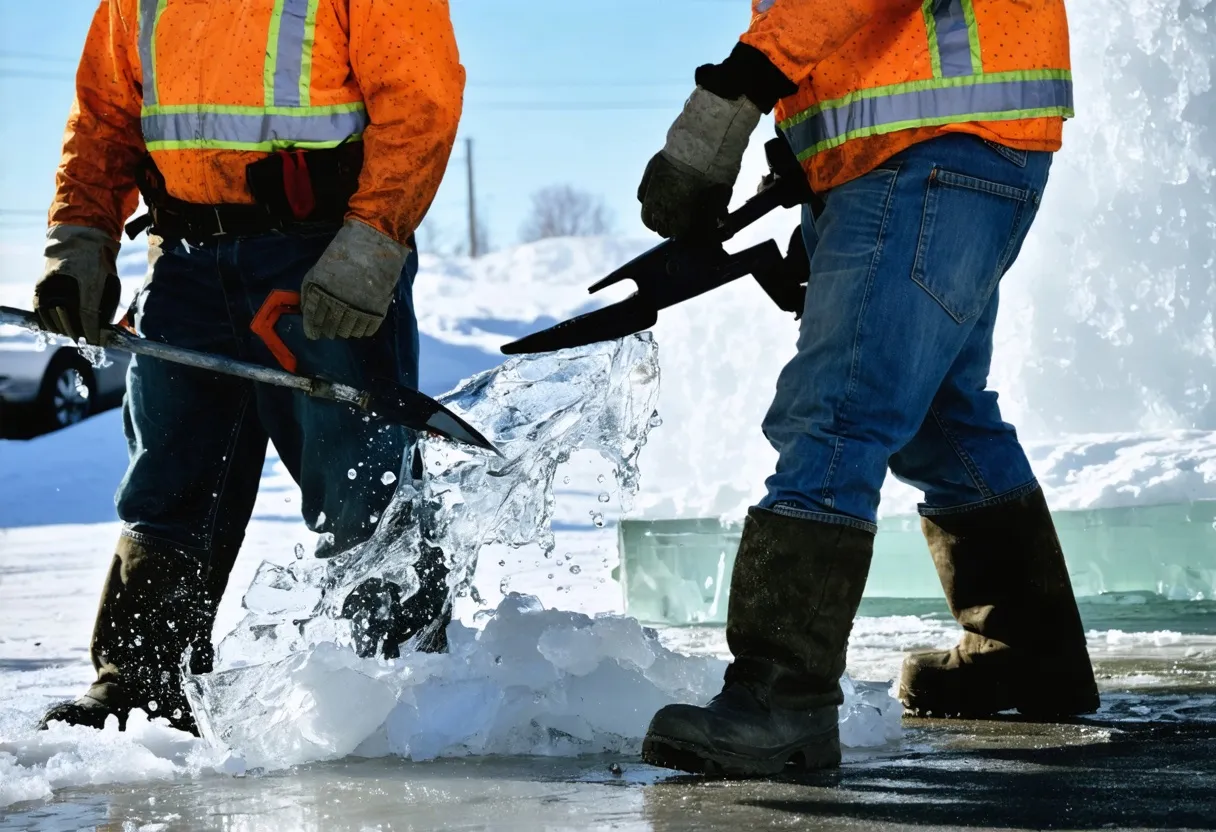
An ice dam doesn't start at your gutter line. It starts wherever your roof is losing heat it shouldn't be losing, and Fairbanks winters are built to punish exactly that weakness. Heavy snow piles up, a stretch of subzero cold gives way to a sudden thaw or a run of bright midday sun, and the bottom of that snowpack melts against a warm roof deck before refreezing solid the instant it reaches the unheated eave overhang. What forms there is a ridge of ice thick enough to pond meltwater back up the roof slope, under shingle courses that were never built to hold standing water -- and once that water finds a nail hole, a seam, or a thin spot in the underlayment, it's headed for your insulation, your drywall, and your walls.
We treat ice dam prevention here as a structural-engineering question first and a roofing task second, because in Fairbanks those are genuinely different problems. That distinction matters most on the pre-1994 housing stock that makes up a substantial part of this market -- homes framed before Alaska updated its snow-load provisions to the 40 psf standard, typically with less attic ventilation and a thinner insulation package than current code assumes. On those roofs, stopping ice dams isn't a matter of running more heat cable. It's a matter of understanding how the framing, insulation, and ventilation are interacting, and fixing the actual combination causing the melt-refreeze cycle instead of just managing where the ice piles up.
The Physics Behind Every Fairbanks Ice Dam
Ice dams are a temperature-differential problem before they're an ice problem. Snow resting on a roof deck that's uniformly cold from top to bottom stays put through most of a Fairbanks winter -- it only melts when direct sun warms the surface, and it melts evenly across the whole slope. The trouble starts the moment the underside of that deck is warmer in some spots than others, which is exactly what happens when heated indoor air finds a path into the attic. An unsealed bathroom fan duct venting straight into the attic space, a gap around a recessed can light, a poorly gasketed attic hatch -- each one becomes a small chimney feeding warm air against the sheathing directly above it, all winter long, whether you notice it or not.
Where the Meltwater Actually Goes
Snow sitting above one of those warm spots melts from the bottom up while the rest of the roof stays frozen solid. That meltwater doesn't just disappear -- it runs downhill underneath the remaining snowpack until it crosses the exterior wall line and reaches the eave overhang, the one section of roof with no heated living space underneath to keep the water liquid. There, it refreezes on contact. The next melt cycle adds another thin layer of ice on top of the last one, and by the coldest stretch of the season that ridge can be thick enough to back several inches of standing water up the roof slope, pressing against shingle laps that assume gravity, not standing water, is doing the work of keeping your house dry.
Fairbanks pushes this mechanism harder than most climates ever see. Long runs of deep cold followed by an abrupt thaw, or a clear day with strong low-angle sun hitting a snow-covered slope, create exactly the freeze-thaw whiplash that grows a dam fastest -- and the snow sitting on top of that whiplash is heavy enough that even a reasonably well-insulated roof can start damming in a shaded valley or a north-facing section that never gets direct sun to help it shed evenly. A roof built for this climate has to manage both variables -- uneven heat loss underneath, and real snow load on top -- at the same time, not one at the expense of the other.
What an Early Look at Your Roof and Attic Catches
Pre-1994 Roofs and the 40 PSF Snow-Load Gap
Alaska updated its snow-load provisions in 1994 to require roofs handle a 40 psf ground snow load, a change that reflected what Interior Alaska winters were actually delivering versus what older framing standards had assumed. A meaningful share of homes across Fairbanks, North Pole, and the surrounding area were framed before that update, which means the structure holding the roof up -- not just the shingles on top of it -- may be carrying less margin than current code expects it to.
That matters directly for how we approach ice dam prevention, because the fixes are not weight-neutral. Ice and water shield membrane adds weight. A second roofing layer installed over an existing one adds more. Even heat cable, if the ice it's meant to manage keeps building up around it anyway, adds load right at the eave -- typically the thinnest-framed section of an older roof. Before we recommend prevention work on a pre-1994 structure, we look at the framing itself: rafter or truss spacing, sheathing condition, and any visible deflection, so the plan reflects what the roof can actually carry, not just what will stop the next dam from forming this winter.
Sag Is a Structural Signal, Not a Cosmetic One
A roofline that dips or wavers between rafters on an older Fairbanks home isn't something to paint over or leave for spring. It's usually the most visible evidence that a roof is working harder than it was designed to under real Interior snow loads, and it needs to be evaluated before any further prevention work -- heat cable, added insulation, a new underlayment layer -- goes on top of a structure that may already be flexing more than it should.
Not every older home has this problem. But the only way to know your specific roof's condition is a structural look at the framing and sheathing, not an estimate written from the driveway. We'd rather tell a homeowner their roof checked out fine than let a real structural issue go unflagged because nobody climbed into the attic to look.
How We Build a Prevention Plan for Your Roof
We inspect the shingle field, insulation depth and coverage, soffit and ridge ventilation, and -- on pre-1994 homes -- the visible framing, to find what's actually driving heat loss and structural risk on your building.
You get an itemized breakdown of what's needed -- ventilation correction, insulation, heat cable, underlayment, or structural attention -- so you can see exactly what each piece costs and why it's on the list.
If a dam is already backing water into your attic or ceiling, we clear it with low-pressure steam and stabilize the roof before any longer-term prevention work begins.
Ventilation and insulation corrections go first where they're the underlying problem, with heat cable and ice-and-water-shield membrane layered on to manage what structural fixes alone can't reach.
On chronic problem roofs, we follow up during the following winter to confirm the fix is holding before calling the job finished.
Already Seeing Water at Your Eaves or a Ceiling Stain?
Standing water behind an ice dam doesn't wait for a convenient afternoon. We treat active leaks as a same-day priority and clear the ice with low-pressure steam -- not a hatchet or ice chopper, which routinely cracks shingles and punctures the deck it's trying to protect.
Ice Dam Prevention Questions Fairbanks Homeowners Ask
Does heat cable alone stop ice dams for good in Fairbanks?
Usually not by itself. Heat cable keeps a channel open for meltwater to drain, which helps immediately, but if the underlying cause is uneven attic heat loss, the roof deck is still warming unevenly under the snow. Cable manages where the ice forms; it doesn't stop the heat loss causing it, so you end up running it hard through every cold snap without ever solving the root problem.
How do I know if it's one bad valley or a whole-attic ventilation problem?
Look at the pattern. A bare, snow-free patch over one specific room or fixture usually points to localized heat leakage -- an uninsulated duct, a can light, a gap around a chimney chase. Ice building up evenly across the entire eave line more often points to an attic-wide ventilation imbalance. We check both from inside the attic during inspection rather than guessing from the ground.
Is my pre-1994 home actually at structural risk, or is that overstated?
Not every older home has a problem, but the 1994 snow-load update reflected a real gap between what a lot of older Fairbanks roofs were framed for and what Interior winters actually deliver. The only way to know your roof's condition is a structural look at the framing and sheathing, which we include as part of inspecting an older home rather than treating it as an optional add-on.
What should I do the moment I see a stain spreading on a winter ceiling?
Call right away rather than waiting for spring. Moisture sitting in attic insulation and framing for months does far more damage than the original leak, and a dam that's actively pushing water into your ceiling gets worse with every hour it sits. We respond to active leaks the same day.
Can prevention work be spread across more than one season?
Yes. Because we quote ventilation correction, insulation, heat cable, and underlayment as separate itemized pieces rather than one bundled number, you can prioritize the root-cause items first and phase the rest as budget allows.
Will adding attic insulation by itself fix a chronic ice dam?
Only if ventilation is balanced at the same time. Insulation stuffed into the eaves without clear soffit airflow can actually trap warm, moist air against the deck and make damming worse. The two have to be corrected together, which is why we check both during the same inspection.
Serving Fairbanks and the Surrounding Interior
We work on ice dam prevention and removal across Fairbanks and the surrounding Interior, including North Pole, Fort Wainwright, Ester, Chena Ridge, and Fox. The physics of a melt-refreeze dam and the snow-load history behind our older housing stock don't change from one side of the borough to the other, but every roof's specific mix of insulation, ventilation, and framing does -- which is why we start every job with an actual inspection of your building instead of a generic package.
If you're planning ahead of winter, staring down a chronically wet ceiling stain from last season, or you've got ice building up at the eaves right now, the starting point is the same: a real look at the roof and attic, an itemized plan built around what's actually causing the problem on your building, and a straight answer about whether a pre-1994 frame needs attention before anything else goes on top of it. If water is already coming through, that call shouldn't wait -- everything else can be scheduled once the active leak is stopped.
Request Your Free Roof Quote
Tell us about your roof and we'll get back to you with honest, upfront pricing.
More roofing services
Get a Straight Answer About Your Roof
Reach out for a free, no-pressure quote built around how your roof actually holds up to Fairbanks winters.