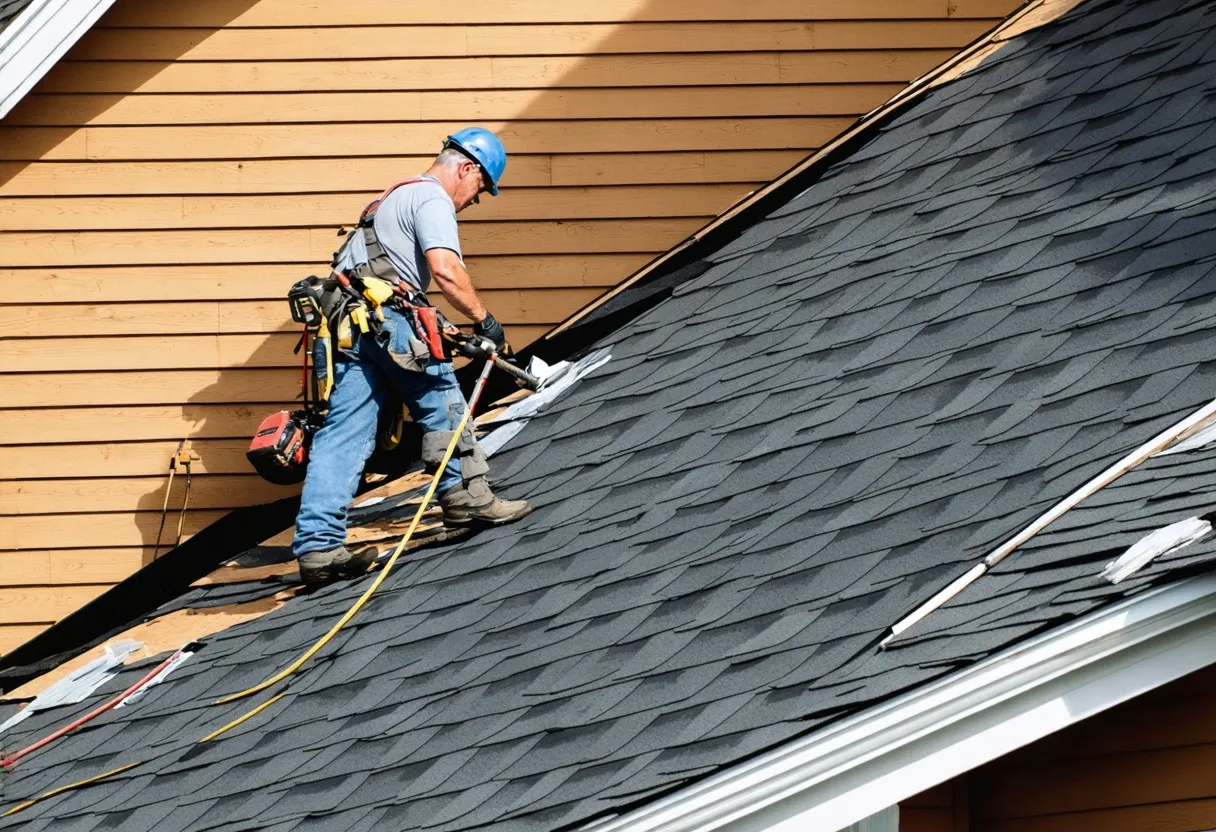
Roof repair in Fairbanks isn't the same trade you'd hire in Seattle or Denver. Interior Alaska puts a roof through extremes most systems were never designed for: deep sustained cold, heavy snow loads, and the freeze-thaw cycling that turns a small shingle gap into a full ice dam by February. If you own a home in North Pole, work out of Fort Wainwright, or live out toward Ester, Chena Ridge, or Fox, your roof is doing structural work every winter that most manufacturers' warranties never anticipated. Getting it repaired by someone who understands that physics -- not just someone who can nail down a shingle -- is the difference between a fix that lasts and one you're paying for again next spring.
This page covers what roof repair actually involves in this market: how ice dams form and how to stop them, what a proper leak repair looks like on a Fairbanks roof, why ventilation is often the root cause of problems homeowners blame on "bad shingles," how moss and algae take hold during our short wet season, what a real inspection covers, and how storm and emergency repairs work when you need someone now. We'll also walk through roofing types, costs, and how to vet a contractor before they're on your roof.
Why Fairbanks roofs fail differently
A huge share of the Fairbanks-area housing stock was built before 1994, back when snow load requirements in local building codes were lighter than what's recommended today. Many of these older roofs were framed for loads well under the 40 psf (pounds per square foot) snow load that's now considered appropriate for this climate. That's not a defect you can see from the ground -- it's a structural margin problem that shows up only when a heavy snow year, a poorly ventilated attic, and an aging roof deck all stack up at once.
Combine that under-built framing with our climate pattern -- heavy snowfall accumulation followed by sharp temperature swings -- and you get the two things that drive most repair calls in this market: ice dams and moisture-driven deck failure. When snow on a warmer upper roof melts and refreezes at a colder eave, it backs water up under the shingles. On a roof with adequate structure, good ventilation, and a proper ice-and-water barrier, that's a manageable seasonal event. On a roof that's marginal on all three counts, it's how leaks, rot, and eventually sag get started. Any Fairbanks repair worth paying for has to account for this -- not just patch the symptom.
Shingle roof leak repair in Fairbanks
Shingle leaks in this climate rarely come from one obvious cause. What looks like a single missing shingle is often the visible end of a chain: wind or ice lifted a tab, water got underneath, it tracked along the underlayment, and it's now showing up as a stain on a ceiling that's nowhere near the actual entry point. A proper shingle roof leak repair starts by tracing the water, not just replacing what's visibly damaged.
Common failure points we find on Fairbanks shingle roofs:
- Nail pops and cracked seals from repeated freeze-thaw movement in the deck
- Lifted or missing tabs at the eaves and ridge, where wind uplift and ice dam pressure concentrate
- Failed flashing around chimneys, plumbing vents, and skylights -- often the single most common leak source on older homes
- Worn or absent ice-and-water shield at the eaves, valleys, and around penetrations, which is the barrier that's supposed to stop ice dam backup from reaching the deck
- Granule loss and brittle shingles on roofs 15+ years old, where the asphalt has simply cycled through too many freeze-thaw seasons
The repair itself typically means pulling back the surrounding shingles, replacing damaged underlayment and ice-and-water membrane, correcting flashing details, and re-lacing new shingles in so the repair blends with the existing roof plane. On a roof that's otherwise sound, this is a targeted, same-day fix in most cases. If we find the deck itself has soft spots from long-term moisture intrusion, that gets called out and priced separately -- patching over a rotten deck just moves the failure a season down the road.
Roof ventilation repair Fairbanks homeowners actually need
Ventilation is the most underestimated part of roof performance in Interior Alaska, and it's frequently the actual cause of problems that get blamed on the shingles or the weather. Here's the mechanism: heat from the living space rises into the attic. If that heat isn't being vented out efficiently through a balanced system of intake (soffit) and exhaust (ridge or gable) vents, it warms the underside of the roof deck unevenly. Snow on the warm section melts, runs down to the cold overhang past the heated wall line, and refreezes -- which is exactly how an ice dam gets started, independent of how good your shingles are.
Poor ventilation also traps moisture. Warm, humid indoor air that migrates into a poorly vented attic condenses on the cold roof deck and rafters. Over a winter, that shows up as frost on the underside of the roof sheathing, then as water stains, then as mold and soft, delaminating plywood. We regularly find this on homes where the owner assumed the problem was a leak from outside, when the real source was moisture generated inside the house with nowhere to escape.
Signs your ventilation system needs attention:
- Icicles or heavy ice buildup concentrated at the eaves while the upper roof is clear of snow
- Frost or moisture visible on the attic side of the roof deck in winter
- Musty smell or visible mold in the attic space
- Uneven snow melt pattern across the roof surface
- Soffit vents that are blocked by insulation, paint, or debris
Ventilation repair can mean adding or clearing soffit intake vents, correcting baffle placement so insulation doesn't choke airflow, upgrading exhaust venting at the ridge, or in some cases air-sealing penetrations between the living space and attic so less warm air reaches the roof deck in the first place. This is one of the highest-value repairs we do, because it addresses the root cause of ice damming rather than just the symptom on the shingles.
Ice dam prevention: the core of subarctic roof work
Given the climate and the age of much of the local building stock, ice dam prevention deserves its own explanation rather than a bullet point. An ice dam forms in three stages: snow accumulates, heat loss from the house melts the snow layer closest to the roof deck, and that meltwater runs down and refreezes once it crosses over the unheated eave. Repeat that cycle over enough freeze-thaw swings and you get a ridge of ice at the eave line thick enough to back water up under the shingles -- sometimes far enough to reach the fascia, soffit, and interior ceiling.
Prevention works on three levels, and a serious contractor should be able to speak to all three, not just sell you heat cables:
- Insulation and air sealing -- reducing the heat that reaches the underside of the roof deck in the first place. This is the most durable fix and often the most overlooked, especially in older homes.
- Ventilation -- moving whatever heat does reach the attic out before it can melt snow unevenly, as covered above.
- Roof-level protection -- ice-and-water shield membrane at eaves, valleys, and penetrations, correctly sized and installed so that even if a dam forms, water backing up under the shingles hits a sealed barrier instead of bare decking.
Heat cables have a place as a supplemental, targeted fix on problem areas -- but installed alone, without addressing insulation and ventilation, they're treating a symptom on a roof that will keep generating ice dams every winter. On older, pre-1994 homes where the roof structure may already be running close to its load margin, an ice dam's added weight isn't just a leak risk -- it's additional dead load sitting on a deck that wasn't engineered with much spare capacity. That's why we evaluate ice dam issues as a structural and building-envelope question, not just a roofing one.
Moss and algae growth on Fairbanks roofs
Moss and algae aren't just cosmetic. On north-facing roof slopes and shaded sections that stay damp longer through spring melt and summer, organic growth holds moisture against the shingle surface. Over time that accelerates granule loss, degrades the shingle mat, and can work its way under tabs and flashing, giving water a path it wouldn't otherwise have. A roof with visible moss is a roof that's holding moisture longer than it should be.
Moss and algae cleaning should be done carefully -- pressure washing a shingle roof is one of the fastest ways to strip granules and shorten its life. The right approach is a low-pressure treatment with a cleaning solution formulated for asphalt or metal roofing, gentle removal of built-up moss with soft tools rather than scraping, and a review of what's keeping that section of roof damp in the first place -- often overhanging branches, poor drainage, or a shaded roof plane with limited airflow. Where recurring growth is a pattern, we can also discuss preventive treatments and, where relevant, zinc or copper strip installation that helps discourage regrowth over time.
Roof inspections
A proper inspection is the foundation of every accurate repair estimate and every ice-dam-prevention plan. We check the roof surface itself -- shingle condition, granule loss, flashing integrity, valley condition -- but just as importantly, we get into the attic to check insulation depth and coverage, ventilation airflow, signs of past moisture or condensation, and any framing members showing stress or deflection. On older homes, that structural look matters as much as the shingle inspection, given the snow-load margins discussed above.
If you're not sure whether what you're seeing is a minor issue or something that needs immediate attention, a full professional roof inspection in Fairbanks is the right starting point. It gives you a documented condition report you can use to plan repairs, budget for future work, or simply confirm the roof is sound before winter. We recommend an inspection at least once a year for most homes in this climate, and after any significant weather event or whenever you notice ice buildup, interior stains, or a jump in heating costs that might point to attic heat loss.
Storm damage restoration
Interior Alaska roofs take a beating from more than just snow. Wind events can lift shingles or tabs, hail can bruise or crack shingle surfaces, and heavy, wet spring snow can stress a roof structure right as it's trying to shed its winter load. When storm damage happens, the priority is stopping active water intrusion first -- tarping exposed sections, sealing lifted flashing, clearing blocked drainage -- and then doing a full damage assessment once conditions allow a safe, thorough inspection.
For insurance purposes, documentation matters. We photograph and record storm damage in detail before starting repairs, which gives you what you need to support a claim. Storm restoration work can range from a targeted shingle and flashing repair to a full section tear-off and re-roof, depending on how much of the roof system was compromised and how long water had access to the deck before repairs began.
Emergency and same-day roof repair
Some roof problems can't wait for a scheduled appointment -- an active leak during a thaw, storm damage exposing the deck, or an ice dam that's actively pushing water into the house. For situations like that, our emergency roof repair service covers same-day response to stop water intrusion and stabilize the roof, with the full repair scoped and scheduled once the immediate risk is handled. In a subarctic climate, a delayed response to an active leak can mean the difference between a shingle repair and a full deck replacement, so we prioritize getting a tarp or temporary seal in place fast, then following through with a permanent fix.
Roofing types we work on
Repair approach depends heavily on what's actually on the roof. We work across the full range of systems found in this market:
- Asphalt shingle roofing -- the most common residential system in Fairbanks; repairs focus on shingle replacement, flashing, and underlayment as covered above
- Metal roofing -- increasingly popular here for its snow-shedding performance and longevity; repairs typically involve seam sealing, fastener replacement, and panel repair or replacement
- Tile roofing -- less common in this climate but present on some properties; repairs require careful handling to avoid cracking additional tiles during access
- Flat and low-slope roofing -- found on additions, garages, and commercial buildings; these systems need attentive drainage design since standing water and snow load are a bigger risk than on a pitched roof
- TPO roofing -- a single-ply membrane system common on commercial flat roofs; repairs involve seam welding and membrane patching
- EPDM (rubber membrane) roofing -- another flat-roof system, repaired with compatible seam adhesives and patching materials rather than asphalt-based products
Mixing repair materials that aren't compatible with the existing system is a common source of premature repair failure -- an EPDM patch on a TPO roof, for example, won't bond correctly. We match materials to the existing system every time.
Skylight installation and repair
Skylights are one of the highest-risk penetrations on any roof, and in this climate that risk is amplified by ice damming around the curb and condensation from the temperature differential between a heated interior and frigid exterior air. Whether you're having a new skylight installed or repairing flashing on an existing one, the flashing detail and the ice-and-water shield around the curb need to be done correctly the first time -- this is one of the most common leak points we're called out to fix on otherwise healthy roofs.
Commercial roofing
Commercial buildings in the Fairbanks area -- flat and low-slope roofs especially -- carry their own snow-load and drainage considerations, often with larger surface areas and more rooftop equipment penetrations than a typical residential roof. We handle commercial roof repair and maintenance across TPO, EPDM, and metal systems, including leak diagnosis around rooftop units, drain and scupper maintenance, and membrane repair. Regular commercial roof inspections are particularly important given how much weight a large flat roof can accumulate in a heavy snow year, and how much costlier a deferred repair becomes once it involves interior tenant space or equipment.
Request Your Free Roof Quote
Tell us about your roof and we'll get back to you with honest, upfront pricing.
More roofing services
Get a Straight Answer About Your Roof
Reach out for a free, no-pressure quote built around how your roof actually holds up to Fairbanks winters.