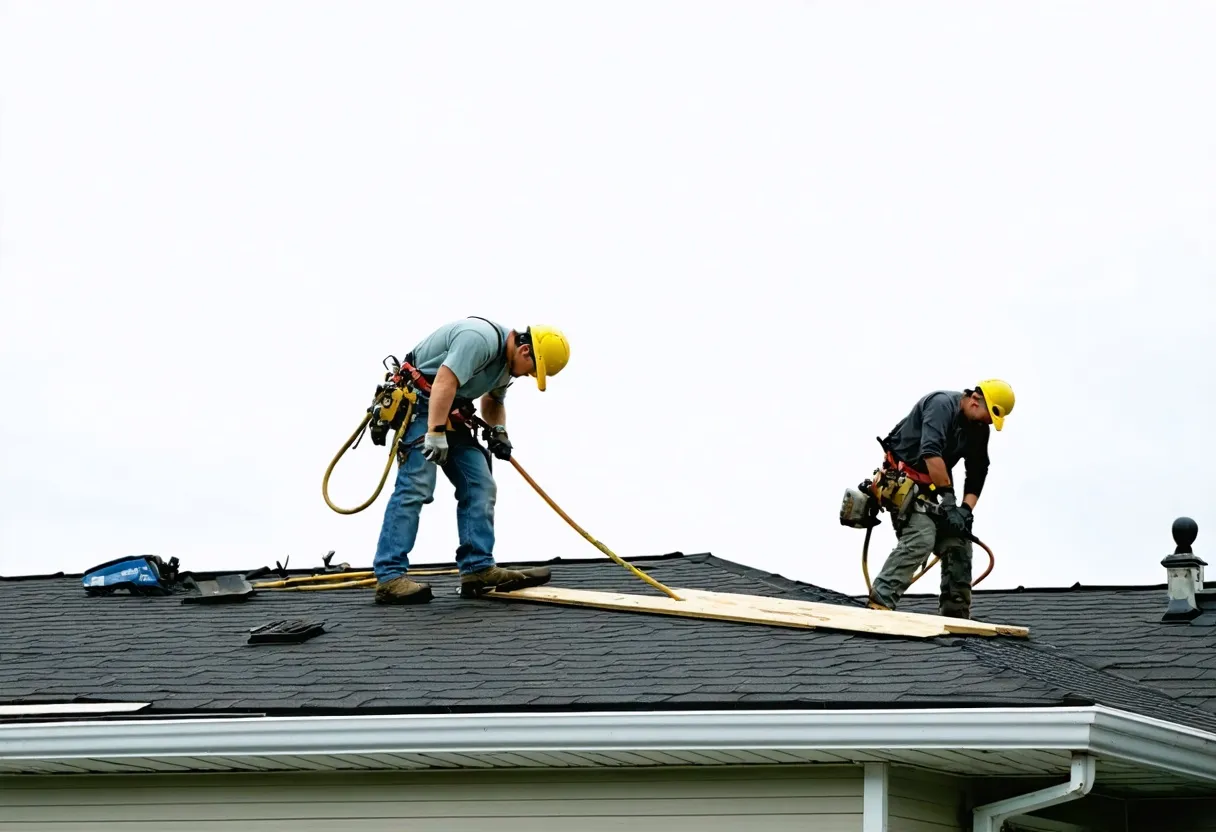
Roof financing in Fairbanks, AK isn't really about spreading out a bill — it's about being able to afford the roof this climate actually requires. A large share of the city's housing stock, from established streets near downtown out to Ester, Chena Ridge, and Fox, went up before the 1994 code revisions that pushed minimum snow-load design closer to the roughly 40 psf standard now used across interior Alaska. That gap matters the moment a roof finally needs work: the job in front of you may not be a straightforward shingle swap. It may include deck reinforcement, ventilation correction, or framing evaluation to bring an older structure closer to what current snow loads actually demand. Those additions raise the total project cost, and that's exactly where financing stops being optional and starts being the difference between doing the job right and doing the cheapest version of it.
This page is written around that reality rather than treated as a generic add-on bolted to the bottom of a roofing quote. Below, we walk through what a financed roofing project should actually cover, how the structural review and approval process fits together on a short building-season timeline, why pre-1994 construction changes the number you're financing in the first place, what proof of a legitimate scope looks like before you sign anything, and what to read carefully in both the loan paperwork and the warranty documentation — whether the property sits in Fairbanks proper, North Pole, near Fort Wainwright, or out toward Chena Ridge.
What a Fairbanks Roof Financing Plan Should Actually Fund
How Financing and the Structural Review Fit Together
Before any financing conversation, a proper inspection checks deck condition, framing, insulation depth, and ventilation balance to see whether a pre-1994 roof was ever built for today's snow-load expectations, not just whether the shingles look worn.
You should receive a scope that separates roofing material, any deck or framing reinforcement, ventilation correction, and disposal costs line by line, so the number you're financing is tied to specific work rather than one lump figure.
Apply through a contractor-arranged lending partner, a bank or credit union personal loan, or home equity financing, and read the APR, term length, and any deferred-interest conditions in full before signing anything.
Approved financing lets a project get slotted into Fairbanks' limited summer construction window rather than waiting, since crews and material orders across the area — Fairbanks, North Pole, Fort Wainwright — fill quickly once the ground clears.
Both the manufacturer's material warranty and the contractor's workmanship warranty should be in your hands, in writing, before your first financed payment is due — not promised verbally and delivered later.
Why Pre-1994 Fairbanks Construction Changes What You're Financing
The single biggest reason roof financing looks different in Fairbanks than in most of the country isn't the cold — it's the code history sitting underneath the shingles. A meaningful portion of the local housing stock, particularly older homes in established neighborhoods and out toward Ester, Chena Ridge, and Fox, was framed before the snow-load design standards were updated to something closer to the roughly 40 psf figure now used across interior Alaska. Those homes weren't built wrong for the era they went up in — they were built to whatever the code required at the time, which was lighter than what current understanding of interior snow accumulation calls for.
That matters because a roof isn't just a weather barrier here; it's a structural system that has to carry real, sustained weight for months at a time. When a roof on one of these older structures finally needs work, the honest scope of that work sometimes goes beyond the roofing surface. It can mean evaluating whether the rafters or trusses need sistering or reinforcement, whether the deck sheathing has been quietly weakened by past freeze-thaw cycling, and whether the attic ventilation is balanced enough to prevent the uneven melting that causes ice dams in the first place. None of that shows up in a quick visual estimate from the ground — it takes an actual inspection of the attic and deck to know what you're really financing.
This is also why two quotes for what looks like the same job can land at very different totals. A bid that only accounts for tear-off and new shingles on a pre-1994 structure may be missing the reinforcement or ventilation correction that a heavier, more thorough assessment would catch. That's not automatically dishonest — it may simply reflect a shallower inspection — but it means the lower number isn't necessarily the more affordable one once winter tests the roof. Financing exists precisely to make the properly scoped version of the job affordable, rather than pushing homeowners toward the thinner bid because it's the only one that fits a cash budget.
Geography plays into this too. Properties around Fort Wainwright and North Pole see the same interior-Alaska snow load and temperature swings as Fairbanks proper, and outlying areas like Chena Ridge and Fox often carry additional tree cover and shading that changes how snow sits on a roof through the season. A financing conversation that's grounded in the actual structure and site — not a generic regional average — is what protects the money you're borrowing.
A Straightforward Quote, No Pressure to Sign Same-Day
You get a written, itemized inspection and quote before any financing discussion starts, and you're free to take that quote to a bank or credit union instead of a contractor-arranged plan. There's no obligation tied to the inspection itself, and no reason to sign financing paperwork the same day you first ask for a number.
What Proof of a Properly Scoped, Legitimate Job Looks Like
When you're financing tens of thousands of dollars in roofing work, the paperwork trail matters as much as the workmanship. Before committing to any payment plan, ask for current documentation of active licensing and both general liability and workers' compensation insurance — not a verbal assurance that a contractor is "licensed and insured," but an actual certificate you can look at. If a worker is injured on your property or the work damages your home, that documentation is what stands between you and personal liability.
The second piece of proof is the quote itself. A legitimate, properly scoped bid on a pre-1994 Fairbanks roof should separate material cost, labor, any deck or framing reinforcement, ventilation correction, and disposal into distinct line items — not one lump-sum figure. If a contractor can't explain why their number is lower than a competitor's for what appears to be the same scope, that's worth asking about directly before financing anything: a lower bid sometimes means thinner materials, skipped ventilation work, or a scope that will quietly grow once the tear-off exposes what's underneath.
It's also worth asking, specifically, how a contractor addresses ice-dam risk beyond simply replacing shingles. A contractor who talks about ventilation balance, attic air-sealing, and deck condition unprompted is demonstrating an understanding of why roofs fail in this climate — heat loss and freeze-thaw cycling, not just snow sitting on top. That's a more reliable signal of thoroughness than any marketing claim, and it's the kind of diagnostic depth that actually protects a financed roof over the life of the loan rather than just getting shingles back on before winter.
Getting more than one written quote before choosing a financing path isn't excessive — it's standard practice for a project of this size, and it gives you a baseline for judging whether the scope, not just the payment, is reasonable.
Roof Financing and Payment Plan Questions Fairbanks Homeowners Ask
Financing is most commonly used for full replacements or major restoration projects because of the dollar amount involved, but many contractors will also finance significant storm or ice-dam damage, particularly when it's paired with a permanent repair rather than just temporary tarping.
Sometimes, particularly for sudden storm or wind damage. Ice-dam damage is more mixed — some policies cover the resulting water intrusion but exclude the ice dam itself if it's attributed to inadequate ventilation or insulation, which insurers can treat as a maintenance issue rather than a covered event. It's worth filing a claim for storm-related damage before financing the gap, but don't assume ice-dam repair will be fully covered.
No. The warranty is tied to the material and the installing contractor's workmanship, not to how the job was paid for. What does matter is making sure the warranty documentation is finalized and in your hands before your financed payments begin, so you're not relying on a verbal promise.
It depends on the lender and product. Contractor-arranged financing partners typically approve a wider range of credit profiles with tiered rates based on score, while bank personal loans and home equity products usually require stronger credit to get the best terms. If your score is on the lower end, ask directly what rate tiers are available rather than assuming you won't qualify.
Given how short the Fairbanks construction season is, it's worth getting a written quote and financing pre-approval done as early in spring as possible, especially for a full replacement. Crews across Fairbanks, North Pole, and the surrounding area book up quickly, and pre-approved financing lets you lock a project slot rather than lose it to someone who was ready to sign first.
Commercial financing usually runs through different products — business loans or phased project financing tied to minimizing downtime — rather than the same consumer lending used for a house. The underlying questions to ask about scope, warranty, and terms are the same either way.
Roof Warranty Terms Fairbanks Homeowners Should Read Before Financing
A financed roof you'll be paying off for years should be backed by warranty coverage that actually protects that investment, and there are two separate warranties worth understanding before you sign anything — they cover different failures and come from different parties.
Manufacturer's material warranty
This covers defects in the shingles, membrane, or metal panels themselves. Read closely for whether coverage is prorated after a certain point in the roof's life, which reduces what you'd actually recover if a material defect shows up later rather than early. This warranty generally follows the product, not the person who installed it.
Contractor's workmanship warranty
This covers installation errors — a completely separate issue from material defects, and it's the warranty most relevant to ice-dam-related failures in Fairbanks, since those are far more often caused by ventilation mistakes or improper flashing than by a bad batch of shingles. Workmanship warranty terms vary meaningfully between contractors, so compare them directly rather than assuming they're roughly equivalent.
Before financing a project, get answers in writing to three questions: what's covered, what specifically voids coverage (improper roof access, unapproved modifications, and similar exclusions are common), and whether the warranty transfers if you sell the property. Also ask who handles a workmanship claim if the installing contractor is no longer operating — manufacturer warranties typically survive independently, but workmanship coverage may not, so it's worth confirming rather than assuming.
The reason this matters for financing specifically is straightforward: if a roof fails prematurely because of an installation error rather than a material defect, you shouldn't be stuck making payments on a loan for a roof that also needs to be redone. Strong, clearly documented warranty terms are what keep a financed roof from becoming a two-time expense.
Request Your Free Roof Quote
Tell us about your roof and we'll get back to you with honest, upfront pricing.
More roofing services
Get a Straight Answer About Your Roof
Reach out for a free, no-pressure quote built around how your roof actually holds up to Fairbanks winters.